

Don’t Fall For These Scams on Substack
A honest look at the fake “growth hacks” on Substack and why real readers are worth the slow climb

When was the last time you said to yourself:
“How the hell did this person get 3,000 new subscribers in two days, while I’m still struggling to get my first 200?”
If you’ve been on Substack for more than a week, you’ve probably already been through this.
And you’ve probably felt as thin as a sheet of paper while watching some “rising star” suddenly explode with growth that seems almost… supernatural.
Welcome.
This is for you and for everyone who has fallen for one of the big Substack scams at least once.

But first, take your FREE Substack Guide ❤️
Sudden Growth: 500–1,000 Subscribers in a Day or Two
Let’s start with my favorite trick.
The one that makes new creators wonder if they’re cursed.
You see a creator who had 120 subscribers yesterday.
Today they have 980.
Tomorrow—1,400.
And you say to yourself:
“Okay… I must be doing something fundamentally wrong.”
But the truth is much more prosaic:
People import huge email lists from outside sources.
From old newsletters, old projects, clients, friends, some dusty CSV file they found on Google Drive.
And Substack counts them as new subscribers.
Boom.
“Sudden growth.”
But that does NOT mean these people are actually reading them, that they have a community, are growing organically, their content is better, or that they’ve discovered some secret formula.
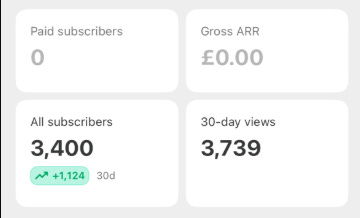
Sometimes their traffic is even suspiciously low compared to the number of subscribers.
With every new subscriber, your traffic goes up by 1 view per person.
Here’s a screenshot of a creator with a huge number of subscribers and ridiculously low traffic, just so you can see how hollow these numbers can be.
For reference only
A creator with 3,000 subscribers gets approximately 18-20,000 monthly views
Here’s a truth worth remembering - A large audience doesn’t mean a lot of attention.
The Fake “Paid Subscribers” Count
This is my other favorite trope.
A creator who sells content on “growth and success on Substack.”
They claim to have over 1,000 paid subscribers.
Sounds impressive, right?
Of course, we won’t name names—it’s unethical.
But…
Every week, they give away paid subscriptions for pennies.
Literally.
Sometimes for $1 sometimes for 50 cents.
Sometimes for a “special promotion” that’s so special it’s cheaper than a coffee from a vending machine.
And the system counts them as paid subscribers.
The stats look impressive.
But in reality, it doesn’t generate real revenue, nor is it sustainable.
And it’s definitely not fair to the people who are trying to grow organically.
And the worst part is that it misleads small creators into thinking:
“What am I doing wrong? Why don’t I even have a single paid subscriber?”
But the truth is simple - Not everything that looks like success is actually success.

Engagement pods
Small groups of people who artificially like and comment on each other’s posts.
They create the illusion of activity.
But this isn’t a community — it’s a barter system.
“I’ll like your post, you like mine.”
Almost the same as “follow for follow.” And then you see a creator you know who posted something that went viral in seconds, and you wonder, “Okay, is my content just not good enough that people don’t like it?”
But the truth is that likes aren’t “I read the post and I love it,” but simply a game of exchange.
Revenue screenshots without context
Someone shows $1,200 a month.
But they don’t tell you that it’s from 3 corporate clients, not from Substack.
Or that it’s from gifted subscriptions, or that it’s from an external audience that has nothing to do with the platform.
I’m writing all this because I’m tired of some of the creators on Substack messing with their readers’ minds and, instead of giving them a helping hand, just making them think that this isn’t possible for them and that they’re constantly doing something wrong.
What do all these things do?
They make people panic, compare themselves to others, think they’re falling behind, and feel small, inadequate, and invisible.
And that’s sad.
Because Substack is a place that’s supposed to be about writing, connection, and community.
Not a competition over vanity metrics.
Slow growth is normal.
A real audience is hard to build.
20 real readers are more valuable than 5,000 dead email addresses.
Trust is earned over time, not with tricks.
And one more thing… You’re not slow. You’re just real.
And real things grow slowly, but they grow strong.
If you’re here, if you’re writing, if you keep showing up again and again
You’re already doing something most people will never do.
Don’t underestimate yourself.
Don’t be fooled.
And above all, don’t give up just because someone else has decided to play with a stacked deck.
You’re playing the long game and it always pays off.

If you’re still reading, here are a few more things you might want to hear:


Recommend to a friend and win prizes. Sharing is caring❤️
If you like my work and want to support me, a coffee is always a great way to do so
© 2026 Creative Hub. This publication is protected by copyright law.
THANK YOU!
THANK YOU FOR TALKING ABOUT THIS🫶🏻🥹 Im sure a lot of people will understand that importing email lists and stuff like that, doesn’t mean building a real connection 🤷🏻♀️
Great encouragement, Tsetsy! Thanks for this. I try to stay focused on showing up authentically as myself, celebrating each individual subscriber, and trusting that I'll get where I hope to get.
Appreciate you!